Confederate Correspondent:
The Civil War Reports of Jacob Nathaniel Raymer, Fourth North Carolina
Winner: Willie Parker Peace History Book Award from the N.C. Society of Historians
$35.00 (order from the publisher) | $28.00 + $3.00 shipping (order from this site)
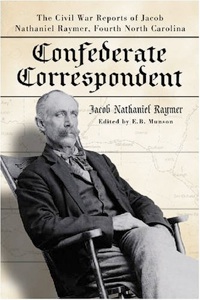
McFarland Publishing Company (2008)
Soon after North Carolina seceded from the Union in May 1861, Jacob Nathaniel Raymer enlisted in the Confederate Army as a private and musician and was mustered in on June 7, 1861, pledged to serve the duration of the war. A young man with a talent for keen observation who had pledged to keep those back home informed of the movements of Company C and the Fourth Regiment, he faithfully wrote letters—often signed simply as “Nat”—to the Carolina Watchman and the Iredell Express, newspapers published in Statesville, NC.
In his capacity as an embedded journalist, Raymer witnessed and chronicled the great battles of the Civil War, including Sharpsburg, Fredericksburg, Chancellorsville, Gettysburg and, finally, Lee’s surrender at Appomattox. Unlike other contemporary correspondence, rather than being directed to an individual, Nat’s letters were intended for the broader audience of area newspapers readers and portrayed the dogged determination of the southern soldiers in a descriptive style whose sense of immediacy functioned to bring the war and all its harsh realities home to his readers. The collection is transcribed primarily from the two newspapers and is complemented by brief narratives that place the letters within the Fourth Regiment’s movements. Raymer’s postwar experience is also documented through his personal correspondence, which follows him back home and to his eventual settlement in Texas, where he died in 1909 at age 72.
– – – – – – – – – – – – – REVIEWS – – – – – – – – – – – – –
This is an excellent work on the writings of Nat Raymer. Private Raymer was mustered in to Company C of the 4th Regiment, North Carolina State Troops (NCST), in 1861, and stayed with the regiment until the very end at the surrender at Appomattox in 1865. He later transferred from the front line troops to the regimental band, where he also acted as a litter carrier and hospital aid during the battles.
Nat Raymer would periodically write long letters to the newspapers in North Carolina about life in the regiment. Some of the letters were funny, some were sad, and all are interesting. They reveal some of the everyday life in the Army of Northern Virginia, especially in George B. Anderson’s Brigade, then in Stephen D. Ramseur’s Brigade, then William Cox’s Brigade of the 4th NCST, 2nd NCST, the 14th NCST and the 30th NCST.
Sometimes, he would list the wounded and dead from the battles, with accounts of how or where they were wounded. Other times he would tell tales of life in the camp, how they lived, and what they ate (or didn’t eat). In any case, this is a good resource of the human interest stories of the Civil War, and a fine addition to the literature of this part of American History.
— R. Lee Hadden, Historian 4th Regiment NCST — Sterling, VA
* * *
…fascinating…a most welcome addition.
— Washington Times
* * *
…adds a local flavor to the first-person accounts of the Civil War…history buffs will find it a great read…
— North Carolina Libraries
* * *
Munson has done an outstanding job transcribing the letters and adding other contemporary 4th North Carolinians to the mix in order to corroborate or illuminate Raymer’s observations. He also adds just enough narrative to place everything in historical context.
— Soldier Studies
* * *
…a good look at the observations and opinions of an intriguing individual…
— The Civil War Times
* * *
Munson transcribes Nat’s letters sent to such newspapers as the Carolina Watchman and the Iredell Express with careful attention to detail, preserving the original spellings of everyday items and place names as was originally written. To read these letters is to step back into history and see the war through Nat’s eyes. This is a wonderful historical record of the period and place, told only as someone who lived through it could.
— NC Genealogical
* * *
A welcome addition to the subject of early journalism.
I came across this book in the course of some research. Raymer is an interesting man because he was not a professional ‘warco’ like Carleton Coffin or Britain’s William Howard Russell, but a serving soldier who provided his local newspapers with the kind of eye-witness material that only the larger titles could hope to obtain through their salaried correspondents. The Confederates were nowhere near as well served by the news media as the Union, so to have this research available is a real boon.
The details of everyday life are excellent, and it is also fascinating to see how honest Raymer was — his confederate-sympathizing readers can have retained few hopes of the South’s ability to gain independence.
Writing about the rough-and-ready surgery, Raymer is blunt: ‘the work of butchery began about noon on the same day, and continued with little intermission until ten o clock the following day. Arms and legs were scattered and tossed about with the utmost indifference.’
Congratulations to the author for bringing Raymer to life through the background research that puts him into context at such a pivotal time in US history.
— J. Hood, Cheshire, United Kingdom [appears on Amazon.com]
 E. B. Munson